

Introduction to Site Structure And Internal Links
In modern SEO, Site Structure And Internal Links play a critical role in determining how well a website ranks, performs, and converts users. Many websites invest heavily in content creation and backlinks but overlook the foundation that holds everything together—how pages are structured and how they connect internally.
At Hawkeye Digital Creators, we’ve seen that websites with clear site architecture and strategic internal linking consistently outperform competitors, even with fewer external backlinks. This guide explains everything you need to know in a practical, human-friendly way.
What Is Site Structure?
Site structure refers to how your website’s pages are organized, grouped, and linked together. It defines the relationship between your homepage, category pages, subcategories, and individual content pages.
A strong site structure ensures:
- Search engines can crawl all pages efficiently
- Users can easily find what they need
- Authority flows logically across the website
Types of Website Structures
- Hierarchical Structure – Most common for blogs and business websites
- Flat Structure – All important pages are close to the homepage
- Silo Structure – Content grouped by topics for authority building
- Linear Structure – Often used in funnels or courses
What Are Internal Links?
Internal links are hyperlinks that connect one page of a website to another page on the same domain. For example, linking a blog post to a related service page or another blog article.
Types of Internal Links
- Navigation Links – Menus, headers, footers
- Contextual Links – Links within content body
- Breadcrumb Links – Show page hierarchy
- Footer Links – Support pages and categories
Why Site Structure And Internal Links Matter for SEO
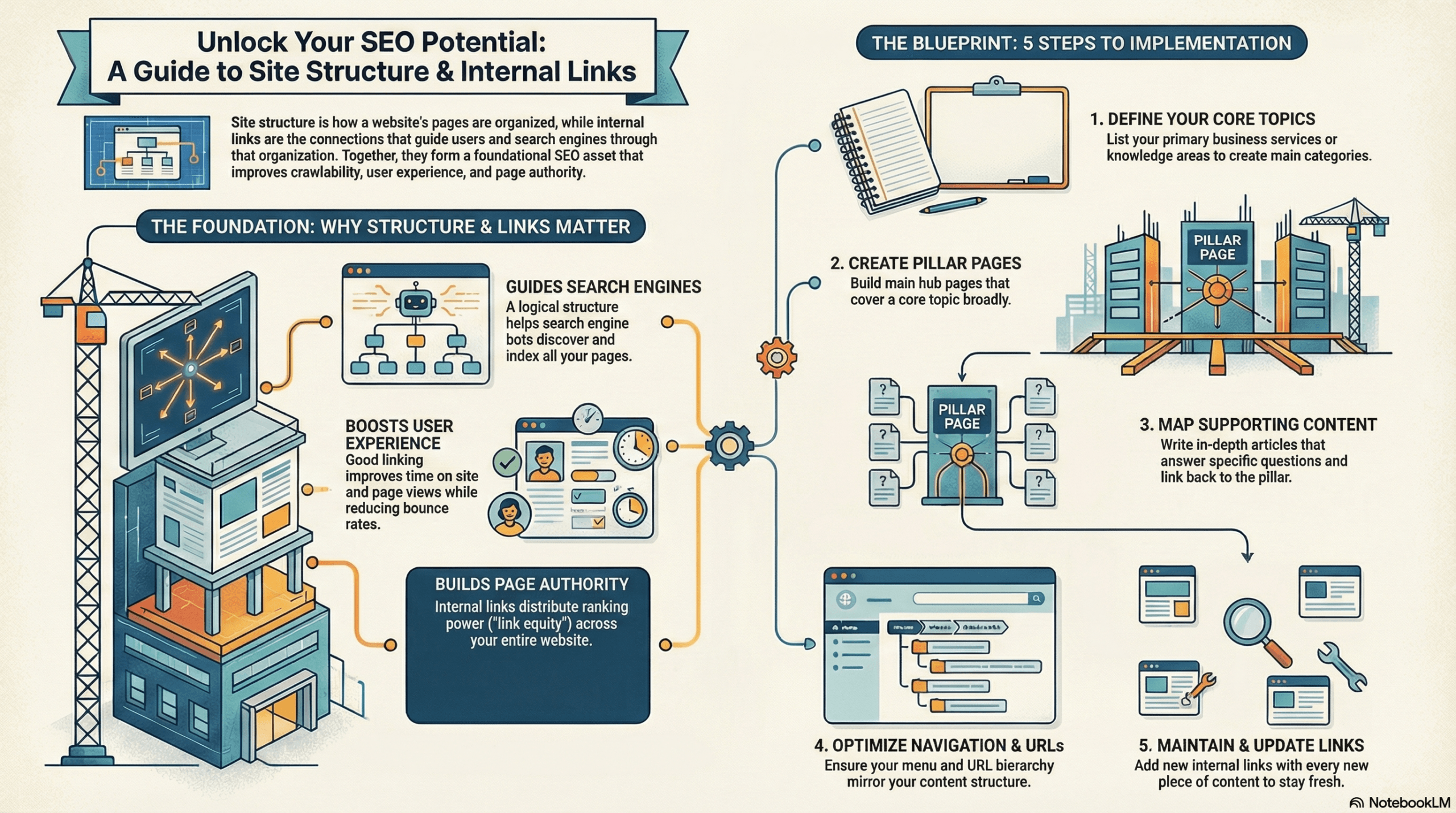
Crawlability and Indexing
Search engine bots follow internal links to discover and index pages. A poor structure can leave important pages orphaned and invisible.
User Experience and Engagement
Logical internal linking improves:
- Time on site
- Page views per session
- Bounce rate
Page Authority and Link Equity
Internal links distribute link equity from high-authority pages to supporting pages, improving rankings across the site.
What are ‘Contextual Links’?
Internal links that are placed within the main body of content.
Relationship Between Site Structure And Internal Linking
Site structure defines the roadmap, while internal links act as roads connecting every destination. Without internal links, even the best structure fails.
Together, Site Structure And Internal Links create clarity for both users and search engines.
How Search Engines Understand Your Website
Search engines analyze:
- URL hierarchy
- Internal linking patterns
- Anchor text relevance
- Content depth
When pages are logically connected, Google understands topic relevance faster and ranks content more confidently.
Best Practices for Creating an SEO-Friendly Site Structure
Flat vs Deep Structure
A flat structure ensures important pages are reachable within 2–3 clicks from the homepage.
URL Hierarchy Optimization
Example:
- example.com/seo/
- example.com/seo/site-structure/
Navigation and Menu Design
Menus should reflect your core services and content silos without overwhelming users.
Internal Linking Best Practices
Anchor Text Optimization
Use descriptive, keyword-rich anchor text naturally. Avoid generic terms like “click here.”
Contextual Linking
Links placed within relevant content paragraphs perform best for SEO.
Link Placement Strategy
- Above-the-fold links carry more value
- Avoid excessive links on a single page
Content Silos and Topical Authority
Content silos group related content under one main topic. This strengthens topical authority and improves rankings for competitive keywords.
Example:
- Main page: Site Structure And Internal Links
- Supporting pages: Internal linking strategies, SEO architecture, crawl optimization
Common Mistakes in Site Structure And Internal Linking
- Orphan pages
- Broken internal links
- Over-optimization of anchor text
- Too many links on one page
- Poor mobile navigation
How to Audit Site Structure And Internal Links
Steps:
- Crawl your website
- Identify orphan pages
- Check link depth
- Fix broken links
- Improve anchor text relevance
Regular audits maintain SEO health.
Tools for Managing Site Structure And Internal Links
- Google Search Console
- Screaming Frog
- Ahrefs Site Audit
- SEMrush
These tools reveal crawl issues and internal linking gaps.
Internal Linking Strategy for Blogs, Service Pages, and E-commerce
Blogs
Link new blogs to cornerstone content and older relevant posts.
Service Pages
Use blog content to support service page authority.
E-commerce
Use category-to-product and related-product internal links.
Future of Site Structure And Internal Linking in SEO
With AI-driven search and semantic indexing, topical clarity will matter more than ever. Websites with strong Site Structure And Internal Links will adapt faster to algorithm changes.
Step-by-Step Implementation Framework
Step 1: Define Your Core Topics
Start by listing your primary business services and knowledge areas. For Hawkeye Digital Creators, these may include SEO, technical SEO, content marketing, paid ads, and website optimization. Each core topic should become a main category or pillar page.
Step 2: Create Pillar Pages
Pillar pages act as the main authority hubs. A pillar page covers a topic broadly while linking to in-depth supporting articles. Your Site Structure And Internal Links page is a perfect example of a pillar asset.
Step 3: Map Supporting Content
Supporting pages should answer specific sub-questions such as:
- How internal links affect crawl budget
- Best internal linking tools
- Internal linking for service pages
Each supporting article must link back to the pillar page and to other relevant subtopics.
Step 4: Optimize Navigation and URLs
Ensure your menu reflects your pillars and silos. URLs should follow a clean hierarchy that mirrors your content structure.
Step 5: Maintain and Update Links
Every new page should link to at least 2–3 relevant existing pages. Regular updates keep your internal linking structure fresh and effective.
Measuring the Impact of Site Structure And Internal Links
To understand whether your efforts are working, track the following metrics:
- Crawl stats in Google Search Console
- Pages indexed vs pages submitted
- Average session duration
- Pages per session
- Ranking improvements for supporting pages
- Improved internal linking often leads to faster indexing and noticeable ranking lifts within weeks.
Site Structure And Internal Linking for Different Website Sizes
Small Websites
Focus on a flat structure and strong homepage links. Avoid unnecessary categories.
Medium Websites
Use topic clusters and breadcrumb navigation to maintain clarity.
Large Websites
Enterprise sites require advanced silos, faceted navigation control, and frequent internal link audits to avoid dilution.
Internal Linking and Conversion Optimization
Internal links are not just for SEO. Strategic links guide users toward:
- Service pages
- Contact forms
- Lead magnets
By linking informational content to commercial pages naturally, you improve conversion rates without aggressive selling.
Advanced Internal Linking Techniques
- Use hub-and-spoke models
- Link from high-traffic pages to priority pages
- Refresh old content with new internal links
- Limit links to what adds genuine value
These advanced methods help scale SEO performance.
Frequently Asked Questions (FAQs)
How many internal links should a page have?
There is no fixed number, but links should remain relevant and useful. Quality matters more than quantity.
Do internal links help new pages rank faster?
Yes. Internal links from indexed pages help search engines discover and rank new content faster.
Are footer links bad for SEO?
No, as long as they are relevant and not spammy.
Conclusion
Site Structure And Internal Links are long-term SEO assets that compound results over time. When your content is logically organized and strategically connected, search engines reward clarity and users enjoy effortless navigation. For brands looking to scale organically, investing in internal architecture is one of the smartest moves you can make.
At Hawkeye Digital Creators, we design SEO strategies that are built to last—starting from the structure, strengthening through internal links, and growing through authority.


